

Mapping the Caribbean Real Estate Landscape: Regulated vs. Fragmented
To properly understand the Caribbean real estate industry you need to understand how the Caribbean is situated concerning countries vs territories, this will help explain the ‘regulated versus fragmented oversight’ designation.
In this blog the Caribbean real estate industry is broken down by country, overseas territory, legal system and whether the specific market is regulated versus fractured oversight. Each country and overseas territory has it’s own, unique legal system and market structure. Not every island is a country, some are still overseas territories of France, England and the Netherlands. In these cases the overseas territories usually abide by the same labor laws and real estate legal system as their controlling state or have a hybrid system they have developed.
There are over a dozen distinct Caribbean real estate regulatory environments — some highly structured, others relationship-driven and attorney-centered. For investors, the key is not avoiding fragmented markets — it’s understanding them.
An important thing to keep in mind concerning Caribbean real estate is that necessary data isn’t always available/collected. In some cases brokerages collect their own data and will gladly provide/publish the collected data. Also, some real estate associations collect data and provide it, some don’t.

Several countries are widely regarded as having weak regulation, limited enforcement, or fragmented oversight, which in practice can feel unregulated—particularly to foreign buyers or first-time investors. Caribbean real estate is a very diverse industry so developing a good baseline education concerning the market you are interested in purchasing or selling in is extremely important.
There are 13 independent countries in the Caribbean.
1. Antigua & Barbuda
2. Bahamas
3. Barbados
4. Cuba
5. Dominica
6. Dominican Republic
7. Greneda
8. Haiti
9. Jamaica
10. St. Kitts & Nevis
11. St. Lucia
12. St. Vincent & The Grenadines
13. Trinidad & Tobago
These countries can develop their own tax code, real estate laws, etc.
These are 17 territories governed by the US, UK, France, and the Netherlands:
United Kingdom (British Overseas Territories):
1. Anguilla
2. British Virgin Islands
3. Cayman Islands
4. Montserrat
5. Turks and Caicos Islands
United States Overseas Territories:
6. Puerto Rico
7. United States Virgin Islands
France (Overseas Departments/Collectivities):
8. Guadeloupe
9. Martinique
10. Saint Barthélemy
11. Saint Martin
Netherlands (Constituent Countries & Special Municipalities):
12. Aruba
13. Curaçao
14. Sint Maarten
15. Bonaire
16. Sint Eustatius
17. Saba
If we expand to include mainland Caribbean-facing countries like Belize, Colombia, Venezuela or Guyana, the number changes — but for the islands in the Caribbean, 30 is the clean number.
In the Caribbean, legal systems fall into a few major families — and this directly affects land title systems, conveyancing, MLS integration (if applicable), escrow practices, and enforcement.

Make sure you check out this blog about Overseas Property Purchasing Tips
1. Common Law Systems (British-based)
The following countries follow English common law traditions. Property law is precedent-driven, contract-heavy, and typically uses deed recording systems (though some use Torrens-style title registration).
Independent Countries (Common Law)
1. Antigua and Barbuda
2. Bahamas
3. Barbados
4. Dominica
5. Grenada
6. Jamaica
7. Saint Kitts and Nevis
8. Saint Lucia
9. Saint Vincent and the Grenadines
10. Trinidad and Tobago
British Overseas Territories
11. Anguilla
12. British Virgin Islands
13. Cayman Islands
14. Montserrat
15. Turks and Caicos Islands
U.S. Territories (Common Law with U.S. Federal overlay)
16. Puerto Rico (hybrid — see below)
17. United States Virgin Islands
2. Civil Law Systems (French / Spanish-based)
The following are code-based systems. Property transfers rely more on statutory codes and notaries, less on judicial precedent.
Spanish Civil Law
1. Cuba
2. Dominican Republic
French Civil Law
3. Guadeloupe
4. Martinique
5. Saint Barthélemy
6. Saint Martin
3. Mixed / Hybrid Systems
The following countries combine civil and common law elements.
1. Haiti (French civil roots + local adaptation)
2. Aruba
3. Curaçao
4. Sint Maarten
5. Bonaire
6. Sint Eustatius
7. Saba
8. Puerto Rico (Spanish civil foundation + U.S. federal common law overlay)
Summary
Common Law Majority
The majority of the island Caribbean operates under British common law traditions.
Civil Law Block
Primarily Spanish- and French-influenced jurisdictions.
Hybrid Systems
Mostly Dutch Caribbean + Haiti + Puerto Rico.

Understanding Caribbean Real Estate: Fragmented vs. Regulated Markets
Understanding regulatory fragmentation vs structured oversight in Caribbean real estate isn’t academic — it directly impacts trust, deal flow, legal risk, and scalability. The Caribbean real estate industry is often spoken about as if it were one unified market. In reality, it is a patchwork of legal systems, regulatory philosophies, and professional oversight standards. For investors, developers, brokers, and international buyers, understanding which jurisdictions are tightly regulated — and which operate under fragmented or informal oversight — is critical.
-Regulated Markets (Formal Licensing & Oversight)
-Fragmented or Lightly Regulated Markets (Limited Licensing Structure)
-
A regulated real estate market has formal laws, licensing requirements, and a government body overseeing brokers and agents.
-
A fragmented oversight market lacks centralized regulation, and responsibility is spread across attorneys, notaries, and informal brokerage networks.
Let’s break it down and offer some insight.
1. Regulated Real Estate Markets in the Caribbean
These jurisdictions have formal licensing requirements for brokers and agents, regulatory boards or commissions, and defined disciplinary frameworks.
In these countries, you typically see:
– Mandatory licensing exams
– Continuing education requirements
– Registered brokerage structures
– Government or statutory oversight bodies
– Clear escrow and trust accounting rules
The Bahamas
The Bahamas operates under a structured licensing system governed by the Real Estate (Brokers and Salesmen) Act. Agents and brokers must be licensed, and the Bahamas Real Estate Association (BREA) plays an influential professional role.
Jamaica
Jamaica has one of the most developed regulatory systems in the English-speaking Caribbean. The Real Estate Board oversees licensing, conduct, and compliance. Practicing without a license is illegal. Enforcement concerning certain aspects can be an issue.
Trinidad and Tobago
Trinidad & Tobago operates under the Real Estate Agents Act, requiring registration and regulatory compliance for agents and brokers.
Barbados
Barbados has formalized licensing under its Real Estate Agents Act, bringing structure to what was historically relationship-driven brokerage.
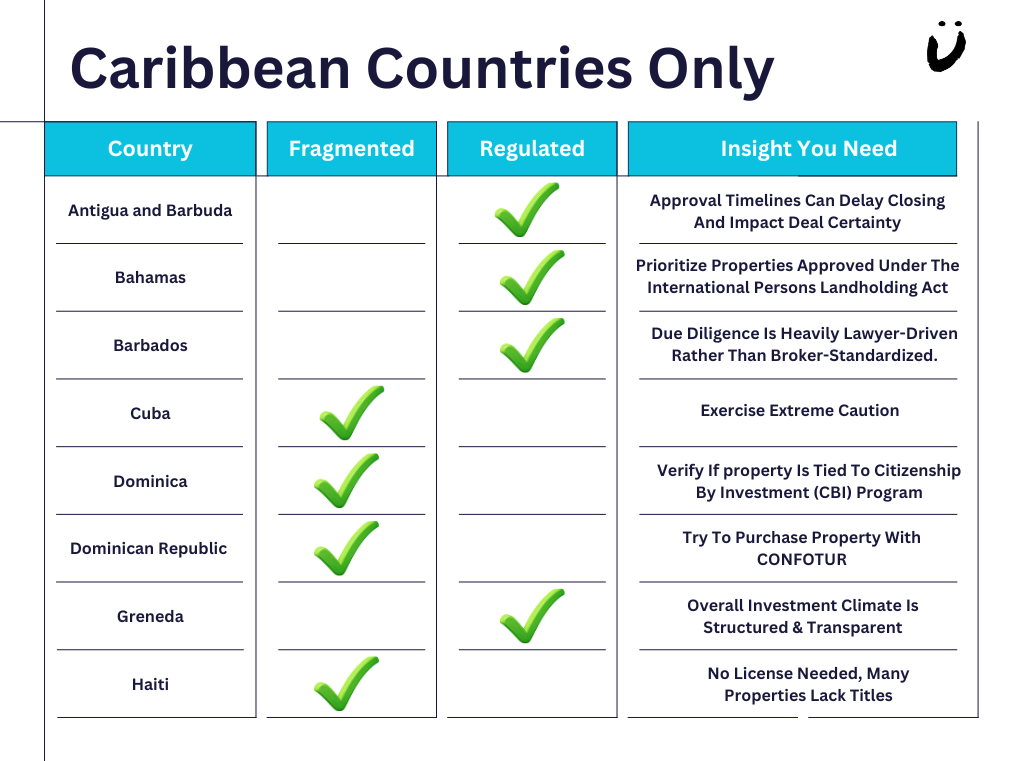
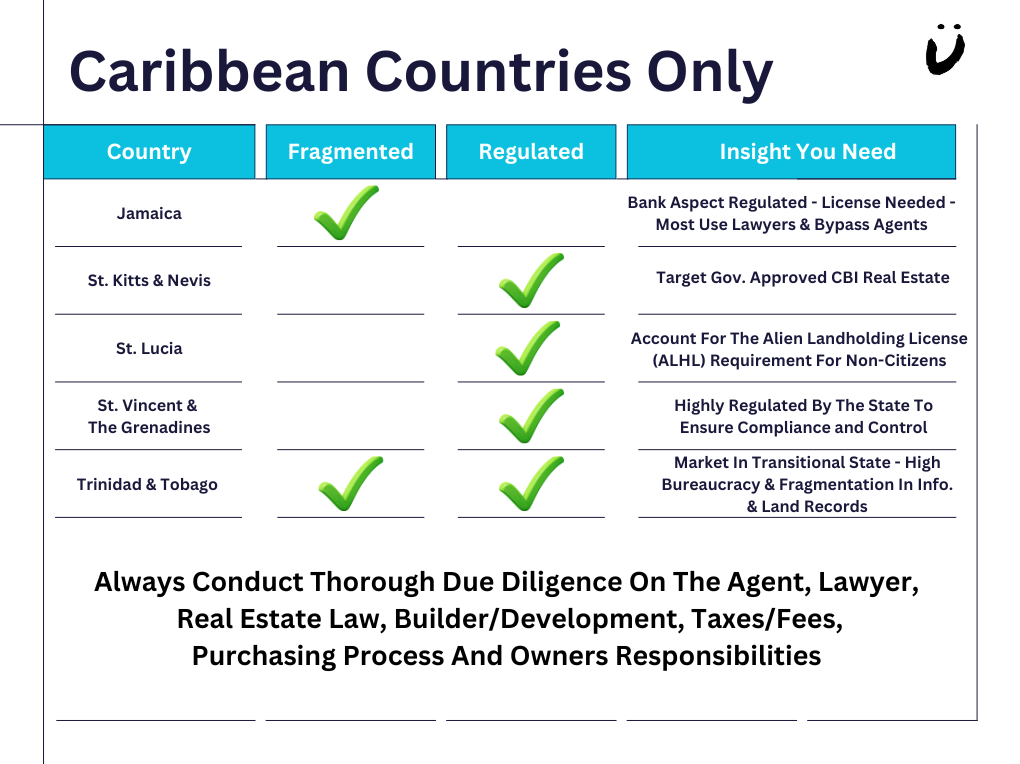
2. Fragmented Oversight or Lightly Regulated Markets
Meaning the market is not unified (multiple independent listing channels, inconsistent data, localized boards, limited nationwide MLS infrastructure, variable transparency, and many small sub-markets rather than one consolidated market). In a fragmented market, real estate activity is legal — but there may not be a centralized licensing authority.
Real estate fragmentation can happen if there is no central MLS (multiple listing service), multiple disparate listing sources, uneven data transparency, or many small local markets each with distinct pricing & rules. Some Caribbean countries have highly consolidated markets (strong institutional reporting, big developers, consistent data), while others are more fragmented (lots of small brokers, informal listings, limited centralized data).
Caribbean real estate is inherently fragmented in many places because of geography (many islands), legal systems, and diverse market participants. Fragmentation does not necessarily imply low investment potential — it can signal opportunities for brokers, platforms, and tech solutions that aggregate listings or standardize data.
The Dominican Republic has a fragmented oversight market, large population centers and investor participation, while smaller islands and Cuba remain more fragmented.
In these jurisdictions there may be:
No mandatory licensing system
No central regulatory body
No formal disciplinary structure
Heavy reliance on attorneys and notaries
Informal or relationship-based brokerage networks
This does not mean these Caribbean real estate markets are unsafe — it means due diligence and legal representation become even more critical.
Cuba
Real estate activity is state-influenced and highly restricted compared to open-market systems. Private brokerage is limited and regulated through different mechanisms than Western systems.
Haiti
Haiti lacks a comprehensive real estate licensing framework. Transactions are often attorney-driven and highly relationship-based. Due to the current environment throughout Haiti it is highly advised to not purchase property unless you are a citizen.
Antigua & Barbuda
While professional associations exist, there is no fully centralized, mandatory licensing body comparable to Jamaica or The Bahamas.
Grenada
Grenada has active brokerages and strong foreign investment flow (particularly via CBI programs), but lacks a strict, exam-based licensing regime.
Saint Lucia
Saint Lucia operates largely through broker networks and legal oversight, without a robust statutory licensing framework.
The Unique Caribbean Reality
Unlike the United States — where licensing is universal at the state level — the Caribbean blends native tax/civil law structure, hybrid models, and certain financial regulatory reforms. Each island is effectively its own regulatory ecosystem. Over the past decade, more Caribbean countries have moved toward formalizing brokerage laws. Barbados being the most recent country. Increased foreign investment, citizenship-by-investment programs, and international banking compliance pressures have accelerated this shift.
In Caribbean real estate fragmented markets, vetting and due diligence become your competitive advantage. In fragmented oversight markets, trust is built manually where as in regulated markets, trust is partially institutional.
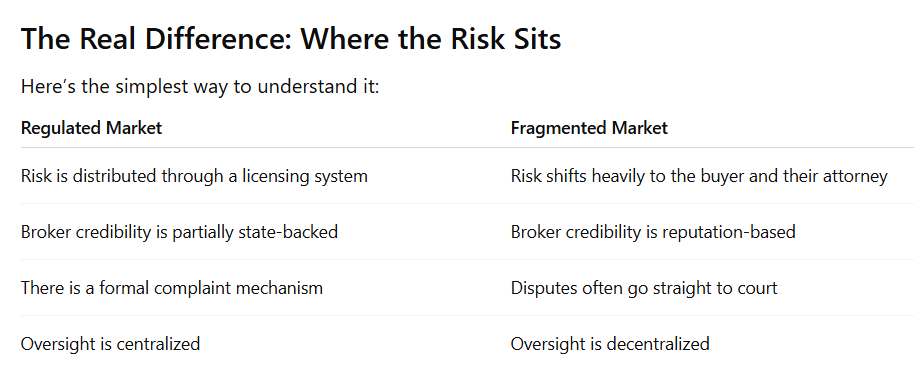
Neither model is automatically “better.” They just allocate responsibility differently.
When you understand the dynamics of regulated and fragmented oversight markets of Caribbean real estate, you gain strategic advantages that most buyers/sellers never see. Knowing the ins-and-outs of the tax laws can be extremely beneficial as a buyer, so always do your homework before you make any moves towards purchasing.
In regulated jurisdictions, ignorance isn’t a defense. Ignorance in fragmented oversight markets can be a financially costly decision.
The Bigger Picture
The Caribbean isn’t disorganized.
It’s diverse.
Common law islands.
Civil law systems.
Former British colonies.
Spanish-influenced jurisdictions.
Emerging regulatory frameworks.
If you understand that Caribbean real estate mosaic, you have the opportunity and insight to treat it like a structured investment landscape. Recognizing the Caribbean real estate mosaic changes how you maneuver, where you buy and how you buy.
It’s extremely important that your real estate agent understand the regulatory or fragmented oversight market you are buying in, if not, they can cost you a lot of time and money. If the agent does not understand the Caribbean real estate market and can’t maneuver correctly then they bring problems into the transaction, so it’s important that you as a potential buyer do your homework and research everything thoroughly.
If you have any questions about purchasing Caribbean real estate then feel free to reach out here.
